
How to choose your first deer rifle
Choosing a first deer rifle is simpler than the internet makes it look. Accuracy matters more than anything else, and the popular choices are popular for a good reason. This guide covers what to think about before you spend any money. It is general guidance, written for stalking in England, Wales and Scotland, and it is not a recommendation of any particular make.
Before you buy. You cannot take a rifle home until your certificate covers it, so choose and buy once you have it. Some constabularies interpret the law into a policy that says you cannot pay more than 49% of the cost of a rifle before your certificate covers it, and that to do so is unlawfully purchasing a firearm. We could find no legal basis for this in consumer law or firearms law. However, it is important to respect that constabularies may have their reasons for these policies, so check with yours before you pay anything. If you have not applied yet, start with our guide to applying for a firearm certificate.
In short
- An accurate rifle that you practise with regularly beats a bigger calibre or newer rifle that you shoot badly, so invest in practising.
- Choose a deer legal calibre that:
- has ammunition that is available in most gun shops
- is affordable
- most manufacturers chamber rifles in
- Choose a calibre you have experience shooting.
- If you put the bullet in the right place, calibre and bullet construction matter much less.
- Keep the rifle light and the barrel no longer than about 22 inches.
- Budget for a good scope, mounts and a moderator, and get the whole thing set up and zeroed at a range.
Accuracy comes first
Accuracy is the most important factor. That means an accurate rifle in any deer legal calibre, and practising regularly. Calibre choice is always hotly debated, but it is far from the top priority.
No animal ever survived long with a hole in its heart, no matter how small the hole. So regardless of what you read about calibres and bullets "pencilling" through an animal, if you put the bullet in the right place, calibre and bullet construction are not that important.
Choosing a calibre
Popular calibres are popular for a reason. As long as a calibre is deer legal, they all work on deer. Avoid the hype about the latest calibre, and avoid buying what someone else says you should. Choose a calibre that:
- is deer legal where you will stalk
- has ammunition that is readily available and affordable
- gives you plenty of choice of rifle, because not every manufacturer makes rifles in every calibre
- you have experience shooting
Do not assume bigger is better. A common mistake for new stalkers is to buy as big a calibre as their licensing authority will allow, and then find they cannot shoot it accurately. The recoil is too much for a new shooter, the ammunition is expensive and hard to get, so practice is rare and accuracy suffers.
The legal minimums
The law sets minimum figures for the rifle and ammunition you use on deer. These are the figures for England, Wales and Scotland. All the figures in a row apply together, and muzzle energy is measured at the muzzle.
| Where | Deer | Minimum calibre | Minimum bullet weight | Minimum muzzle energy | Minimum muzzle velocity |
|---|---|---|---|---|---|
| England and Wales | Red, fallow, sika and roe | .240 inch | None set | 1,700 ft lb | None set |
| England and Wales | Muntjac and Chinese water deer | .220 inch | 50 grains | 1,000 ft lb | None set |
| Scotland | Red, sika and fallow | None set | 80 grains | 1,750 ft lb | 2,450 feet per second |
| Scotland | Roe | None set | 50 grains | 1,000 ft lb | 2,450 feet per second |
In England and Wales the bullet must also be soft-nosed or hollow-nosed. A rifle under .240 is only legal for muntjac and Chinese water deer in England and Wales. In Scotland there is no calibre minimum, and roe can be shot with a .22 centrefire rifle that meets the roe figures. The .243 Winchester is above the .240 minimum in England and Wales.
The England and Wales figures come from section 4, section 6(6) and Schedule 2 of the Deer Act 1991. Certificates and the rest of firearms law are covered by the Firearms Act 1968. In Scotland the 80 grain minimum was set by a 2023 order amending the older Scottish deer order. Laws change, so check the current figures before you buy, and check them again if you plan to stalk in Scotland. The Northern Ireland rules are different and are not covered here.
Lead ammunition is being phased out
The UK government intends to phase out most uses of lead ammunition over the coming years. For rifles, the dates currently planned are 1 April 2028, when restrictions on lead bullets for outdoor target shooting begin unless the range has approved environmental risk measures, and 1 April 2029, when a ban on the use and sale of lead bullets for live quarry shooting is planned for calibres of 6.17 mm (.243) and above. Rifles below 6.17 mm are not affected by the live quarry ban.
For most deer stalking, that means non-lead bullets will become the standard. They are typically copper or a copper alloy, they are often slightly longer than lead bullets, they can affect how the bullet stabilises in the barrel, and they may need testing and re-zeroing. Dates can change, so check the current position. The British Deer Society explains the restrictions in its article on lead ammunition restrictions.
The .243 Winchester and lead-free ammunition
The .243 Winchester is still a very valid calibre choice for deer stalking in the UK. Some stalkers worry that it cannot shoot lead-free ammunition accurately. Copper is lighter than lead, so copper monolithic bullets end up longer than lead ones, and a longer bullet needs a faster twist to stabilise it.
Manufacturers and UK distributors have responded to the growing popularity of lead-free ammunition. Many factory .243 rifles now come with a 1:8 or 1:7.5 twist rate instead of the older 1:10, and these can usually shoot monolithic bullets accurately. If you are considering a .243 and you plan to use lead-free ammunition, check the twist rate before you buy.
Which deer will you be stalking?
Which species you meet depends on where you stalk, so think about this before you choose. Broadly, roe are the most widespread and are found in nearly every county. Red deer are mostly found in upland areas. Muntjac have spread out from the Home Counties across southern England. Chinese water deer are found mainly in East Anglia and Bedfordshire, and sika are localised, with hotspots across the country. Fallow deer are found in woodland, parkland and farmland.
See the stalking we offer for each species:
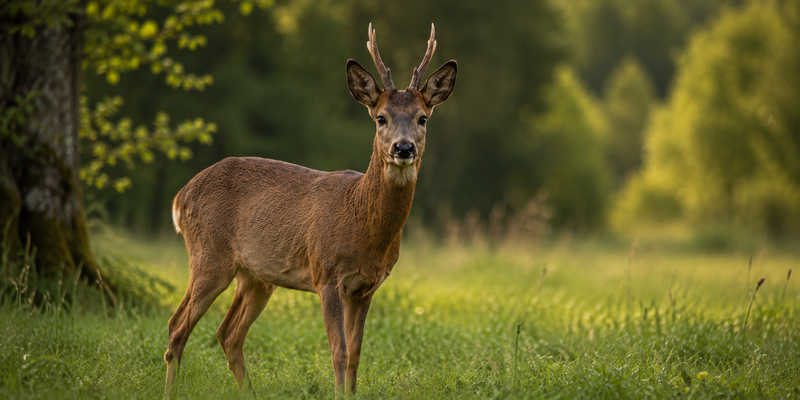
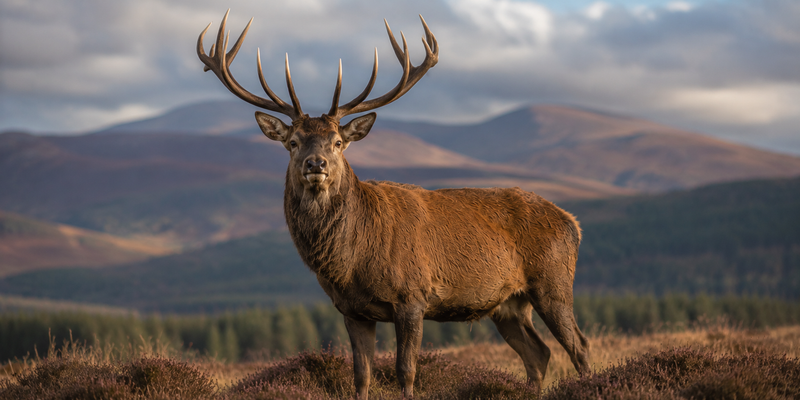
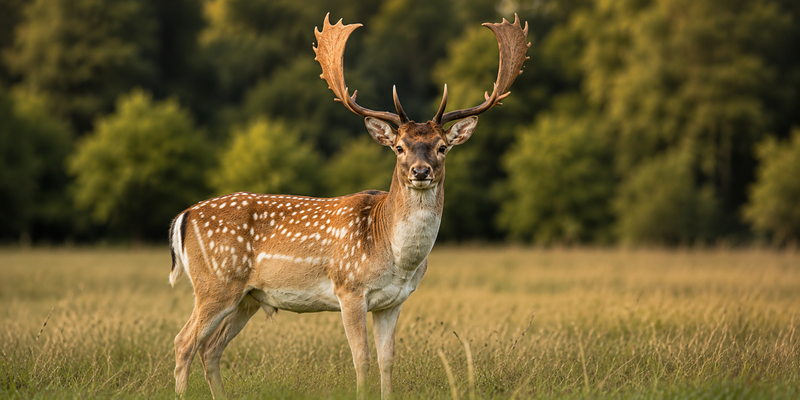


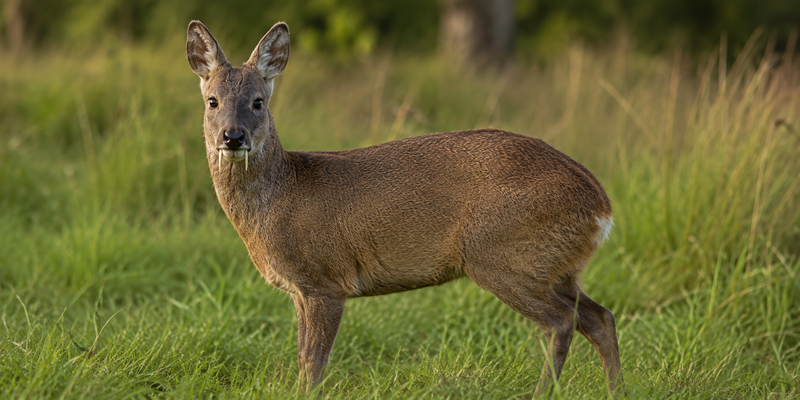
For a closer look at where each species is found, use the British Deer Society's distribution maps. They use squares of no smaller than 10 km, so they show where a species is found, not whether it is on a particular piece of ground. Ask the ground's owner or your guide what you are likely to see.
Bullet construction
Bullet construction is important, although putting the bullet in the right place matters most. A good deer bullet expands uniformly, which gives it the best chance of continuing on a straight path when it hits the animal. It creates a wide wound channel and delivers its energy, which helps ensure the rapid and humane loss of consciousness and death of the animal.
Keep it light, and not too long
Avoid heavy rifles. A heavy rifle is easier to shoot because it recoils less, but most stalkers spend the vast majority of their time carrying the rifle, not shooting it.
Long barrels are not necessary for a stalking rifle. Beyond about 22 inches a barrel becomes a serious hindrance to moving quietly.

Choosing a make
Do not be too boring in your choice. You should enjoy owning the rifle. But also think about availability: spare parts, scope mounts and magazines. A rifle that is hard to support will be a nuisance in a few years.
Wood or synthetic stock
A wooden stock has the traditional look and feel that many stalkers enjoy. It can be affected by damp weather and knocks. A synthetic stock is usually lighter and tougher, and takes bad weather better. Either works well, so choose the one you will be happy to carry and to look after.

Blued, Cerakote or stainless
Blued steel is the traditional finish and needs regular wiping and oiling to stay in good order. Cerakote is a hard-wearing coating that resists wear and corrosion and comes in a range of colours. Stainless steel resists rust well and needs less care, although a bright finish can reflect light, so many are supplied in a matt finish. Whichever you choose, wipe the rifle down after a wet day.
Scopes and mounts
Choosing a scope is a huge subject, and it deserves an article of its own. For this guide, the main point is about cost. People are fond of saying "spend as much on your scope as you do on your rifle", but that comes from a time when rifles and scopes were cheaper. Rifles used to cost around £1,000, and a top quality European made optic cost about the same. Now commonly available rifles range from £500 to £8,000, and suitable deer stalking optics range from £250 to £4,000.
A European made fixed power optic is a very robust choice for a stalking rifle. Most deer are shot between 50 and 150 metres, so 6x or 8x magnification is adequate. Light transmission and the ability to hold zero matter more than having 20x magnification. A used European fixed power optic can be bought for £150 to £350.
Rifle scopes for deer stalking fall into three broad groups: fixed power, variable power and digital. Fixed power and variable power scopes are optical, so you look through glass. A digital scope shows the image on a small screen.
Fixed power

Pros
- European made fixed power scopes represent excellent value for money.
- They are lightweight and reliable, because they have no moving parts.
- They have fewer lenses and no erector tube, so they are typically better for light transmission than a variable power scope.
- There is no magnification ring to knock or forget to set.
Cons
- They are difficult to source, because most manufacturers do not make them any more, so most are bought used.
- If your eyesight is poor and you refuse to wear glasses, zeroing a rifle with a fixed power scope can be tricky.
- You cannot zoom in to check what you are shooting at.
- You are limited to one magnification, which may not suit every type of ground.
Variable power

Pros
- They are easy to zero, because you can zoom in and see where you hit.
- In bright conditions it is nice to zoom in and check your target.
- You can tune the magnification to suit your exact conditions, so one scope suits both woodland and open ground.
Cons
- They are very expensive. Avoid variable power scopes under £500 for deer stalking, and ideally spend at least £1,000 on a new one. Generally speaking, variable power scopes under £500 have been made to a budget. They are fine for target shooting, but they do not offer the light transmission and reliability that is essential for deer stalking.
- They have more lenses and moving parts than a fixed power scope, and they are heavier.
Digital

Pros
- They are relatively affordable, with popular models at around £400 to £500.
- Light transmission is irrelevant, because the image is digitally enhanced to the point where you can see in total darkness.
- The technology is superb. Many models include laser rangefinders with ballistic compensation indicators.
- Your shot can be filmed, which lets you review it if an animal runs after the shot and cannot be found.
Cons
- They depend on batteries.
- Reliability varies. Software glitches are common compared with the mechanical failings of non-digital scopes.
- They are heavy. Because of the batteries and other internals, digital scopes are often double the weight of a comparable variable power scope.
- You look at a screen, not through glass, which some stalkers dislike.
- Check the rules on shooting deer at night before you use one in the dark.
Mounts
The mounts hold the scope to the rifle, and they matter as much as the scope. A scope that shifts or works loose cannot hold zero, however good the glass is. Do not buy cheap mounts. Aim to spend a minimum of £80, and ideally £150 or more.
Mounts come as a pair of rings or as a one-piece mount. Whichever you choose, it must be made for your rifle, so check that good quality mounts are easy to get for the rifle you are choosing. Pick a height that lets the scope sit as low as it can while still clearing the barrel and the front lens, because a low scope is quicker to get your eye behind and gives a steadier hold.
Have the scope fitted by someone who knows how, so that it is secure and square on the rifle. Then zero the rifle once everything is fitted, and check the zero again after the first few shots.
Moderators
A moderator reduces the noise of the shot and is widely used in deer stalking. It protects your hearing and makes the sound of the shot less disturbing for others nearby. It adds length and weight to the rifle, and it can change where the bullet lands, so always zero the rifle with the moderator fitted. If you want a moderator, choose a rifle with a threaded barrel.
Remove your moderator from your rifle before you put the rifle back in your cabinet. A moderator fills with corrosive gases that can ruin a rifle.

Rifle slings
A sling carries the rifle comfortably and leaves your hands free. Avoid backpack style slings, and backpacks that hold a rifle, unless you are genuinely mountain hunting or walking a long way. They are too slow to deploy in most stalking situations.
Some slings are made from nylon straps, others are made from stretchy, rubber-backed neoprene. Neoprene is an excellent choice for a rifle sling, though most people simply choose a sling that complements the look of the rifle. We personally prefer a nylon sling, because it doubles as a deer drag or as a tourniquet in an emergency.

Rifle slips
A rifle slip is a padded cover that protects the rifle and scope as you walk to the ground and when you move between places. It is a legal requirement to have your rifle covered when it is being transported, and when you take it into a gun shop or similar place. Choose a slip that is padded, that fits your rifle with the moderator on, and that is comfortable to carry.
Bipods
A bipod is useful when zeroing or shooting prone. They are hardly used in lowland stalking, where most stalkers use shooting sticks of some description for standing shots. We prefer quick detach bipods, because they can easily be removed and attached when needed. Picatinny based quick detach options are the best system in our opinion, as they offer the most stable platform to shoot from.

Get it set up and zeroed
Once you have your rifle, get it set up and zeroed properly. Each of the ranges below lets you take a rifle there, assemble it and zero it for a set fee, and each has a gun shop attached, so you can buy your rifle there too. Fees vary, so check with each range.


Where to next

This guide is general information, not advice on any particular rifle or on your own circumstances. Laws and ranges change, so check the current position before you buy.